
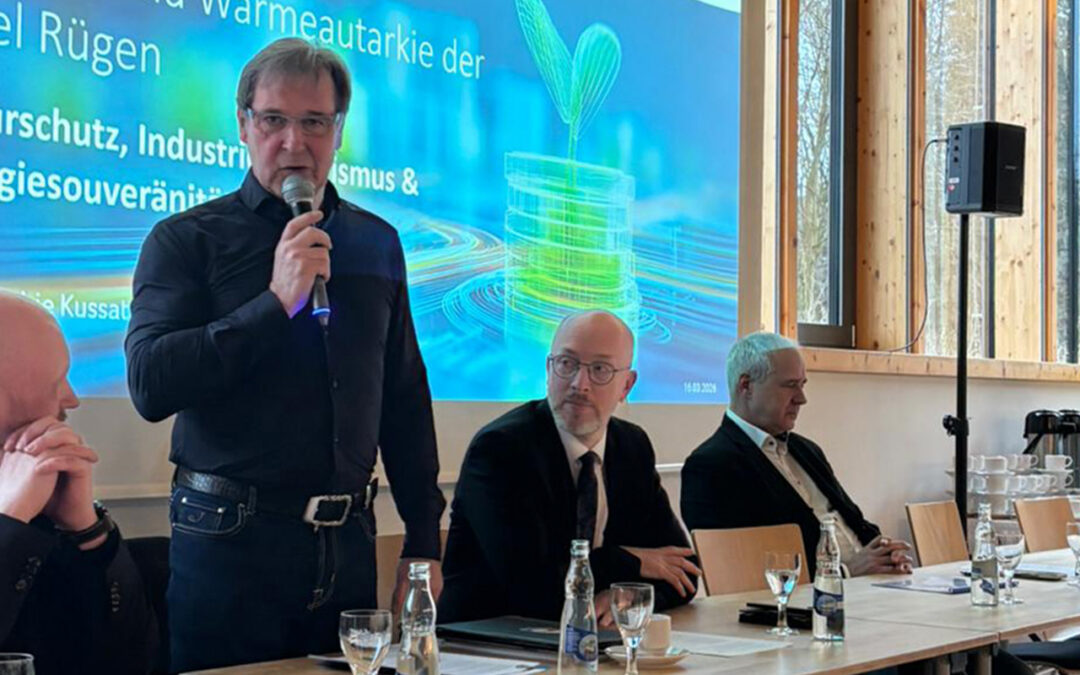
Energy and heating self-sufficiency on Rügen is not only a regional issue for the future, but also a strategic learning ground for the development of resilient infrastructure in Germany. Through the expert and dialogue forum on the island, aconium brought the relevant stakeholders together.
Starting point: Resilience as a guiding principle
Energy and heat supply has long been more than just a technical issue: it affects security of supply, price stability, climate protection and regional value creation in equal measure. Regions such as Rügen in particular face the challenge of embedding tourism, the natural environment, industry and infrastructure within a robust, sustainable energy system. Against this backdrop, the question of resilience is becoming increasingly important from a strategic perspective. The key issue is how regional supply can be structured in such a way that it remains reliable and capable of responding effectively even under changing conditions.
Dialogue forum as a kick-off
At the expert and dialogue forum “Energy and Heating Self-Sufficiency on the Island of Rügen”, representatives from politics, local authorities, business and academia discussed pathways to a future-proof energy and heating supply. The local roots of the issue were particularly evident: numerous mayors from the island, representatives of the district and stakeholders from the housing sector contributed their perspectives. Also in attendance was Christian Pegel, Minister for the Interior and Construction of the State of Mecklenburg-Western Pomerania, who has been supporting the region’s infrastructural development for years. The event marks the start of a coordinated development process in which Rügen aims to systematically further develop its role as a model region for the energy transition and climate protection.
Henry Forster, Managing Director of Mukran Port (Fährhafen Sassnitz GmbH), provided concrete insights into the regional implementation prospects. He presented the port as a central building block for Rügen’s energy future: with its strategic focus on becoming a ‘Green Port’, the site is developing into a hub for renewable energy, industrial value creation and maritime infrastructure. In particular, the proximity to offshore wind farms and the existing logistical capacities offer ideal conditions for establishing new value chains in the field of green technologies. The aim is to establish Mukran as a model location for sustainable industrial transformation and as a platform for cross-border cooperation in the Baltic Sea region.
For aconium, a key infrastructural question is at the forefront: how can energy and heat supply in an island region be further developed in such a way that it remains resilient, affordable and regionally anchored? Rügen is thus not only a regional example, but also a relevant point of reference for other areas facing similar challenges.
aconium’s perspective: a transformation pathway rather than an individual project
aconium views energy and heat self-sufficiency as a strategic cross-cutting task that links infrastructure, financing and regional development goals. During the forum, Maxi Sophie Kussatz outlined a possible transformation pathway: Under the title “Energy and heating self-sufficiency on the island of Rügen – nature conservation, industry, tourism & energy sovereignty in harmony”, perspectives were outlined on how an island region can develop step by step towards energy sovereignty. The focus is deliberately not on a finished project, but on a process that highlights options, structures investment needs and involves both local and private stakeholders at an early stage.
Self-sufficiency as a means of regional action
One thing is clear: energy and heat self-sufficiency does not mean isolating oneself from the wider energy and electricity market. Rather, it is about a region’s ability to generate more energy locally, use it intelligently and manage it flexibly – for example, through renewable generation, heating networks, sector coupling and storage solutions. This creates new scope for regional value creation, stable framework conditions for businesses and local authorities, and a concrete contribution to achieving climate targets.
Role in the process
aconium brings to this process many years of experience from infrastructure and digitalisation projects. This experience is particularly relevant where complex projects must be approached not only from a technical perspective, but also by integrating political, economic and regional development considerations. We support regions in translating complex transformation processes into structured, investment-ready steps: from analysis and scenario development to the design of business models and financing strategies.