
For aconium, the trade fair and events calendar for spring 2026 is clearly focused on future-oriented topics: with the polis Convention in Düsseldorf, ANGA COM in Cologne and NØRD in Rostock, the spotlight is on three events where key issues relating to digital infrastructure, local authorities’ capacity to act, transformation and resilient development will be discussed. The focus is not merely on technological solutions, but above all on the question of how infrastructure, data, governance and implementation can be combined in such a way that local authorities, regions and public sector stakeholders remain capable of acting in the long term.
The series kicks off with the polis Convention from 6 to 7 May 2026 at the Areal Böhler in Düsseldorf. The event is regarded as one of the leading platforms for urban and project development in Germany and brings together stakeholders from the public sector, planning, project development and the property sector. At our stand (Stand A02.1), we will be providing information in particular on topics such as funding and financing structures, integrated infrastructure and energy planning, digital transformation and resilient infrastructure, as well as regional development and implementation capacity.
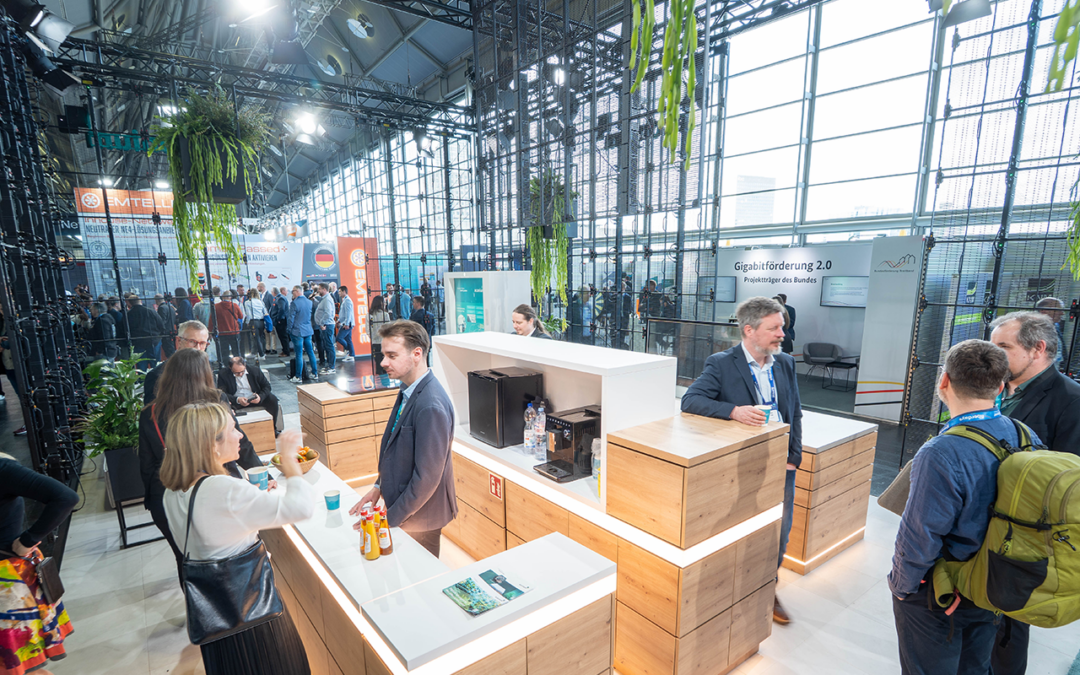
From 19 to 21 May 2026, aconium will be exhibiting alongside the Federal Ministry for Digital Affairs and State Modernisation (BMDS) at ANGA COM in Cologne with a stand dedicated to gigabit funding (Hall 7, Stand D40). As Europe’s leading trade fair for broadband, media and connectivity, ANGA COM offers the ideal setting to provide information on the federal funding programme and to engage in dialogue with representatives from business, administration and politics.
The focus of the exhibition stand will be on the funding process and the individual phases of the Gigabit funding scheme – from application to implementation. Visitors will gain insights into current developments, receive practical advice on project implementation and have the opportunity for direct dialogue with experts.
A special event is the planned municipal utilities lunch on Thursday, 21 May 2026, at 1.30 pm on the Innovation Stage in Hall 7. Catering will be provided at the adjacent ANGA stand, offering space for networking and professional exchange.
aconium is also represented in the congress programme with several specialist presentations:
- Tim Brauckmüller will take part in the panel discussion “Cyber Security Act & Digital Sovereignty: Security as a Cost Driver for Mobile and Fibre Optics?” on 20 May from 15:45 to 16:30 (Room 1).
- Ellen Greifeneder will provide insights into “The Latest on the Federal Government’s Gigabit Funding” on the Innovation Stage on 21 May from 11.10 am to 11.30 am.
- Widar Wendt will moderate the panel discussion “Accelerated Expansion and Operation through the use of AI” on 19 May from 13:00 to 14:00 (Room 2).
In addition, current topics relating to the Gigabit funding programme will be explored in greater depth at the stand throughout the three days of the fair:
Daily at the stand: Presentation of the new features in the 2026 federal funding programme, with a focus on reducing bureaucracy and speeding up procedures
- Open consultation with Ulf Freienstein
- Dealing with “Homes Passed” in funding projects – presentation of a new information sheet
- Moderated discussion with Ulf Freienstein on best practices and challenges (moderator: Maximilian von Heyden)
aconium and the BMDS look forward to engaging with all interested parties and warmly invite you to visit the stand.
At the end of the month, attention turns to NØRD at the HanseMesse Rostock, taking place on 27 and 28 May 2026. The digital conference brings together topics such as open source, AI in practice, digitalisation of public administration, digitalisation in healthcare, cybercrime, smart cities and digital twins, thereby creating an environment that is highly relevant to aconium’s work on digital and resilient infrastructures. That is why aconium will also be presenting itself at this NØRD with a stand in the central marketplace. We will also be represented with a workshop on smart water management, as well as further contributions on the Main Stage and the Pitch Stage. Further information on this will follow in our May newsletter.
Pitch Stage 27 May 11:40 – 11:45
Nora Simon
From location to value creation: actively shaping data centres and securing added value for local communities
How to successfully establish municipal data centres – from strategic positioning through dealing with land pressure, energy issues and acceptance to securing concrete added value. The focus is on key questions and starting points for an active municipal role. The presentation shows how municipalities can move from a reactive approach to an active shaping role and integrate data centres meaningfully into their own development.
Pitch Stage 28 May 11:30 – 11:35
Maxi Kussatz
Digital solutions for resilient civil protection: A catalyst for better protection of the civilian population and critical infrastructure
This presentation provides an overview of how digital solutions can strengthen the resilience of public institutions – particularly in civil protection, public warning systems and disaster management. The focus is on fundamental approaches to efficient processes and modern administration in a crisis context. The aim is to provide impetus for better protection of the civilian population and critical infrastructure.
Workzone 28 May 12:15 – 13:10
Jutta Hoffmann
Smart water management – How local authorities can tackle climate change and extreme weather
Germany is not a water-scarce country. However, climate change is altering rainfall patterns. The growing challenge lies in the temporal, spatial and qualitative availability of water – for agriculture, urban water management, ecosystems and municipal services. The presentation demonstrates how water resilience, as a systemic municipal task, links the aspects of infrastructure, land use, operations, data management and governance. Resilience is often achieved through the modernisation and intelligent control of existing systems. Real-world examples illustrate how nature-based and digital approaches are combined in this process.
The three events cover a wide range of topics, from urban and regional development and broadband and connectivity issues to digital administration and innovation policy.