
One thing became particularly clear: many relevant developments are emerging from Germany and Europe – driven by industrial strength, technological depth and a growing focus on digital sovereignty.
Physical AI: A definition
Physical AI refers to the integration of AI systems into physical contexts – for example, in humanoid robots, autonomous vehicles, production facilities, care aids or agricultural machinery. Unlike digital AI systems such as large language models or analytical AI, which primarily evaluate data, generate text or optimise processes, Physical AI operates in the real world. It not only processes information but also controls physical actions, thereby generating immediate consequences.
This distinction is not trivial. With the transition into the physical world, requirements regarding reliability, safety, liability, corporate responsibility and social acceptance change fundamentally. A language model that provides an incorrect answer can be corrected. An autonomous system that fails in manufacturing or road traffic can have irreversible consequences.
What Hannover Messe 2026 shows: maturity rather than prototypes
A tour of the exhibition confirmed an assessment already under discussion in the D21 working group on Physical AI: the technology has moved beyond the prototype stage in many areas. Collaborative robots, autonomous transport systems for logistics and intralogistics, and AI-supported quality control in manufacturing are no longer concept studies – they are already in productive use or on the verge of it.
Use cases from real-world production environments proved particularly illuminating: Physical AI is not tested there in the abstract, but is introduced to address clearly defined tasks – such as process optimisation, reducing the workload on staff, or quality assurance. This shows that the move towards Physical AI does not necessarily have to take place via large-scale transformation programmes. It can also be successfully achieved through clearly defined, manageable use cases. The priority now is to develop solutions specifically for SMEs, thereby making productivity gains widely accessible.
Platforms, simulation and data as the foundation
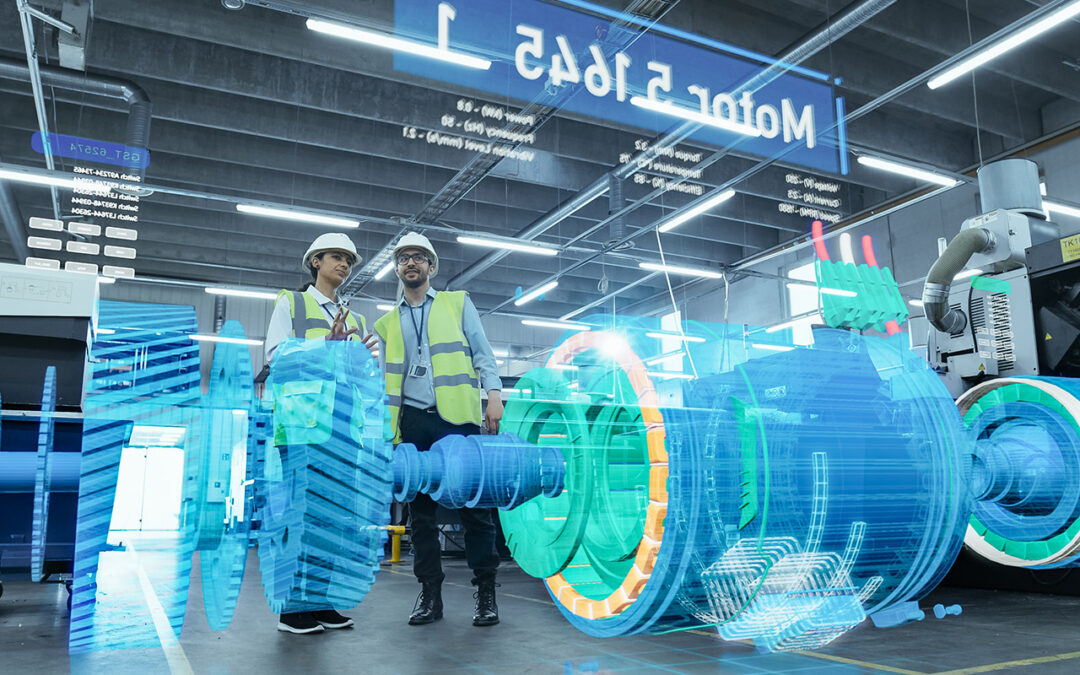
It also became clear that Physical AI does not develop solely through more powerful robots. The interplay of hardware, software, data, simulation and integration platforms is crucial. Digital twins, virtual training environments and reusable data models are becoming essential for developing, testing and integrating applications safely into existing production landscapes.
This is particularly crucial in so-called brownfield environments. Many companies are not introducing Physical AI on a greenfield site, but within existing machine fleets, process chains and IT structures. Open interfaces, technology-neutral platforms and flexible integration models can make all the difference here – particularly for small and medium-sized enterprises that wish to implement specific use cases without having to build their own large-scale research structures.
Human-machine collaboration as a guiding principle
The dominant narrative at the trade fair was not full automation, but cooperation: systems that complement, relieve and extend human work – not replace it. This shift in perspective is significant because it addresses the question of acceptance, which is crucial for the widespread societal adoption of Physical AI.
Nevertheless, it remains to be seen how these guiding principles will translate into real-world working conditions. The trade fair showcases technical possibilities – but in many areas, these possibilities have yet to be negotiated with employees, trade unions and society.
Technological sovereignty as a strategic dimension
Physical AI is also a question of technological sovereignty. Whoever controls the platforms, simulation environments, data flows, models and integration architectures will shape future value creation. For Germany and Europe, this is a strategic turning point: Do we want to be primarily users of Physical AI systems developed, trained and scaled elsewhere – or do we want to remain co-creators of this generation of technology?
Hannover Messe demonstrated that Europe possesses strong industrial foundations: experience in automation, mechanical engineering expertise, sensor technology, actuator technology, materials knowledge, production know-how and application-oriented research. It will be crucial to combine these strengths with data, platform and infrastructure approaches.
Social issues we need to discuss
The tour of the fair was deliberately designed as a dialogue: not just viewing technology, but asking questions. The impressions gained on site have deepened several lines of discussion that the Physical AI Working Group of Initiative D21 has already identified as central:
- Regulation and testing environments: Technical maturity and the regulatory framework are not currently developing at the same pace. Particularly as Physical AI moves beyond closed production environments into public spaces, care, healthcare or mobility, there is a need for clear responsibilities, liability rules, safety requirements and controlled testing opportunities. Work and skills: Physical AI is transforming job profiles – in manufacturing, logistics and the skilled trades, but also in healthcare and care. The question is not only which jobs will disappear, but which new ones will emerge and how training pathways need to be designed.
- Trust and acceptance: The social acceptance of Physical AI does not depend solely on technical performance. Crucial factors include transparent value propositions, comprehensible decision-making logic, the involvement of affected groups, and credible safety concepts.
- Positive visions of the future beyond industrial automation: Public perception of automation and robotics is still often characterised by a fear of displacement. We need concrete, tangible application scenarios that demonstrate what Physical AI can enable for people – in agriculture, medicine, disaster relief, care, but also in everyday life.
The role of D21 and aconium
With its Physical AI working group, Initiative D21 positions itself precisely at this interface: between technological development and societal shaping. Physical AI is coming – the question is whether we as a society will actively shape this development or merely reactively accompany it.
Against this backdrop, a curated tour of the trade fair was organised for members and sponsors of Initiative D21 at Hannover Messe, in the context of the D21 Physical AI working group, which is co-chaired by aconium. Together with D21 board member Jens-Rainer Jänig (Managing Director of mc-quadrat GmbH), we led the tour on site. At selected stops, participants gained insights into specific applications in robotics and autonomous systems, simulation and industrial AI.
The tour of the Hannover Messe 2026 offered D21 members the chance to see this issue with their own eyes: in concrete, tangible terms and in dialogue with those working on its implementation. At aconium, we see our role as combining technological analysis with strategic relevance, thereby contributing to informed societal judgement.
Physical AI is not a technical issue for specialists. It is a policy issue for everyone who bears responsibility for the economy, politics and society. The 2026 Hannover Messe highlighted this impressively.