
Smaller municipalities such as Bad Belzig are using programmes like the Model Projects Smart Cities competition to actively shape digital development and test their own solutions for urban development, administration and essential public services. If this is to become more than a temporary funding episode, it needs to create value that continues to hold up once the funding has expired.
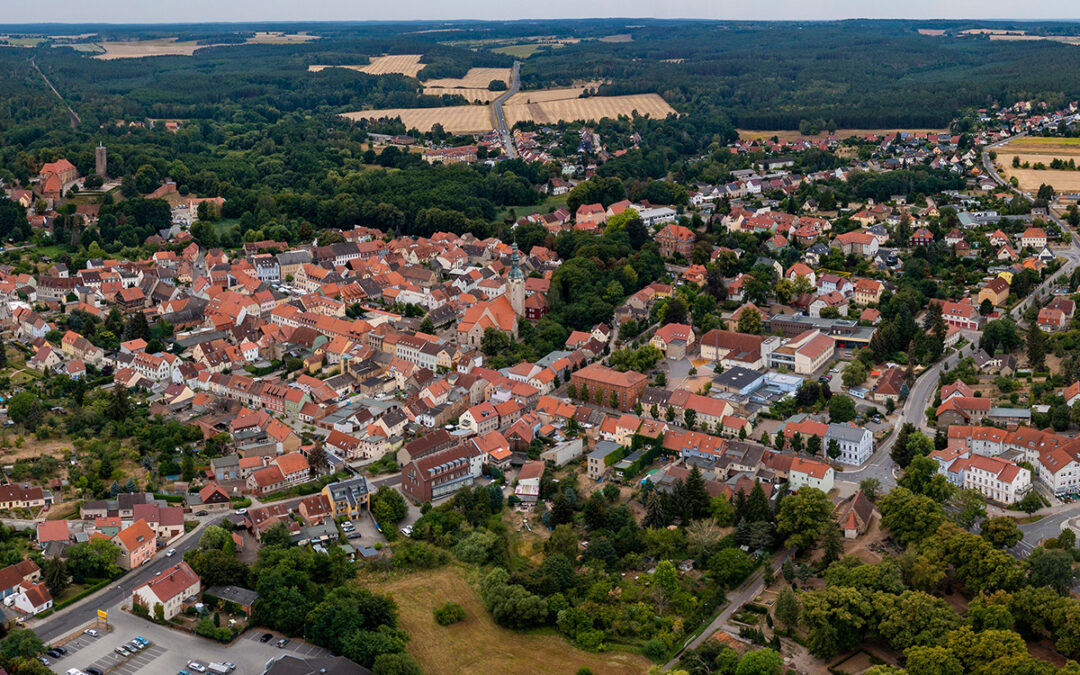
Anyone who associates a spa town with tranquillity would not be wrong about Bad Belzig at first glance. The restored old town in the Hoher Fläming Nature Park in Brandenburg, around 80 kilometres south-west of Berlin, visibly bears the mark of European funding programmes and is overlooked by Eisenhardt Castle, founded in the ninth century. It is not necessarily the first place where one would expect a pioneering role in digitalisation. And yet Bad Belzig, together with the neighbouring municipality of Wiesenburg, is part of the Model Projects Smart Cities programme and is showing how digital development can also be tested in practice in smaller municipalities.
The intermunicipal cooperation operates under the name “Zukunftsschusterei”, named after the former shoe shops in which the two project teams initially set up their offices. Behind it lies a clear motivation: to counter migration away from rural areas and become more attractive to digitally minded people from Leipzig, Magdeburg, Potsdam and Berlin. Wiesenburg is also focusing on village community centres, a Smart Village Campus and the repurposing of former industrial sites.
Digitalisation as a field for experimentation
Around €6 million is available to the two municipalities jointly over seven years through the Model Projects Smart Cities programme, with a ten per cent own contribution. Since responsibility for the programme moved to the Federal Ministry for Housing, Urban Development and Building, the focus has shifted more strongly towards integrated urban development rather than classic administrative digitalisation. Environment, quality of life, mobility and society are the central fields of action. Malte Specht, who leads the project in Bad Belzig, describes the approach as deliberately experimental: the idea is to try out different digital tools and observe which ones are accepted by people, can be used in the long term or may even develop into a business model of their own.
The most visible result is the Bad Belzig app. It brings together local news, sends push notifications about waste collection dates, allows users to report potholes or illegal waste dumping via the “Maerker” service, presents local politics and offers digital citizen services such as business registration and deregistration. The focus remains more on information than interaction. A second example is the booking platform Biletado, a joint project with Kiel Region and the Amt Süderbrarup. It enables rooms and equipment in Bad Belzig to be booked, with multi-tenant separation between internal and external use, including online payment. This addresses concrete administrative and everyday needs, rather than only abstract digitalisation goals.
Data-based urban development
Another focus is the field of “planning with data”. A LoRaWAN-based climate data platform uses 104 sensor groups across the town to measure soil moisture – a direct response to the sandy, water-poor soils of the Fläming region, where the Lübnitz district has already lost 60 per cent of its old, heritage-protected tree stock to drought within six years. A dashboard displays moisture values at depths of 30 and 60 centimetres; a citizen science initiative involves residents who, for example, measure their own traditional orchards.
Bad Belzig has deliberately chosen not to build its own urban data platform and instead relies on open-source communities such as The Things Network. Further projects are being planned using this IoT infrastructure, including monitoring water meters at Eisenhardt Castle and measuring room temperatures in the town hall offices in preparation for future energy-efficiency renovations. The example shows that data infrastructure does not have to start on a large scale. What matters is whether it connects to concrete tasks and can be expanded step by step.
What happens next
Continued use beyond the funding period is not mandatory in the Model Projects Smart Cities programme, but it is explicitly encouraged. The Bad Belzig app, which also received funding from the state, is now being used in 50 municipalities in Brandenburg and 20 more across Germany. In Brandenburg, Biletado is currently being used by the town of Guben. Project lead Malte Specht sums up the formula for success: continued use works when municipalities cooperate, develop solutions together and use the same software – the more municipalities share a system, the greater its chances of survival.
Funding in Bad Belzig will end at the end of 2027. Whether and how the projects continue after that will depend on how valuable they have proved to be for the municipality. Legal details often play a decisive role here. If Biletado were to be developed into an event management system for associations, it could quickly fall into the category of an online marketplace under EU law – with correspondingly high requirements. The commercial development of the smart metering network is also not straightforward; nevertheless, there are signs that the municipal utilities may take on an operational guarantee in future and share the costs with the town.
This is precisely where experience comes into play that aconium also knows from supporting municipal funding projects. From a technical perspective, many smart city solutions have long been tested. The real strategic decision lies in who operates a system once funding ends, how operating models can be designed in a legally sound way and whether several municipalities can share a solution. Examples such as Bad Belzig show that these questions are easier to answer the earlier they are considered. This is a central lesson for municipal digitalisation: impact is not created by introducing individual applications, but by building sustainable structures, enabling shared use and developing realistic operating perspectives.