
Approval backlogs, skills shortages, outdated networks: criticism of Germany’s infrastructure is familiar – and yet it tells only half the story. Alongside these structural challenges, a practice-oriented research landscape is emerging in Germany that shows how high-performance networks and intelligent energy systems can fundamentally change industrial processes. Two projects involving aconium provide tangible examples from practical application and offer guidance for Germany’s Mittelstand.
Manufacturing companies are currently facing transformation pressure on several fronts: processes need to become more digital, supply chains more robust and carbon footprints smaller – all while competitive pressure remains high. The common prerequisite for this is infrastructure that can reliably supply, process and translate data into operational decisions. Two projects from very different technological fields show what this can look like in practice: the 5G research project 5G-PortVG and the Interreg project LIHYP on hydrogen supply in the North Sea region. In projects of this kind, aconium contributes its perspective on how technical innovation, location-specific conditions and practical implementation can be brought together.
5G-PortVG: testing campus networks in port operations
Over a period of three years, six partners – project lead DEN GmbH, aconium GmbH, Stralsund University of Applied Sciences, Weiße Flotte GmbH, Witeno GmbH and Nautitronix – examined how 5G campus networks can be used under real-life conditions in ports and on waterways in the Western Pomerania region. The project was funded as part of the 5x5G innovation competition run by the then Federal Ministry for Digital and Transport. Unlike the public mobile network, a campus network operates on its own frequency assigned by the Federal Network Agency – with guaranteed latency, high availability and local, data-protection-compliant data storage. This creates a controllable digital infrastructure, which is particularly important for safety-critical and time-critical applications.
Three applications were tested: real-time control of autonomous vehicles and vessels, the integration of sensor-based environmental detection using LiDAR, radar and GNSS, and autonomous logistics fleets for warehouse management in port facilities. The most striking demonstration was provided by the solar ferry “Sünje” operated by Weiße Flotte GmbH. At the final meeting in November 2024, it navigated autonomously through a predefined corridor on Lake Sellin on the island of Rügen – controlled exclusively by signals from the 5G campus network and without manual intervention. In parallel, Stralsund University of Applied Sciences developed “Little Scientist”, an unmanned surface vehicle that serves as a scalable testbed for navigation and control systems.
For the Mittelstand, the benefits lie in three areas: greater operational efficiency through automated processes, improved safety through continuous sensor monitoring and a data basis that enables AI-supported control and predictive maintenance in the first place. As the project shows, a dedicated campus network is no longer the preserve of large corporations, but a scalable option – from port operators and logistics centres to production sites with complex material flows. The decisive factor is not the radio technology alone, but how network availability, data quality and process requirements fit together.
LIHYP: bringing hydrogen demand and supply together
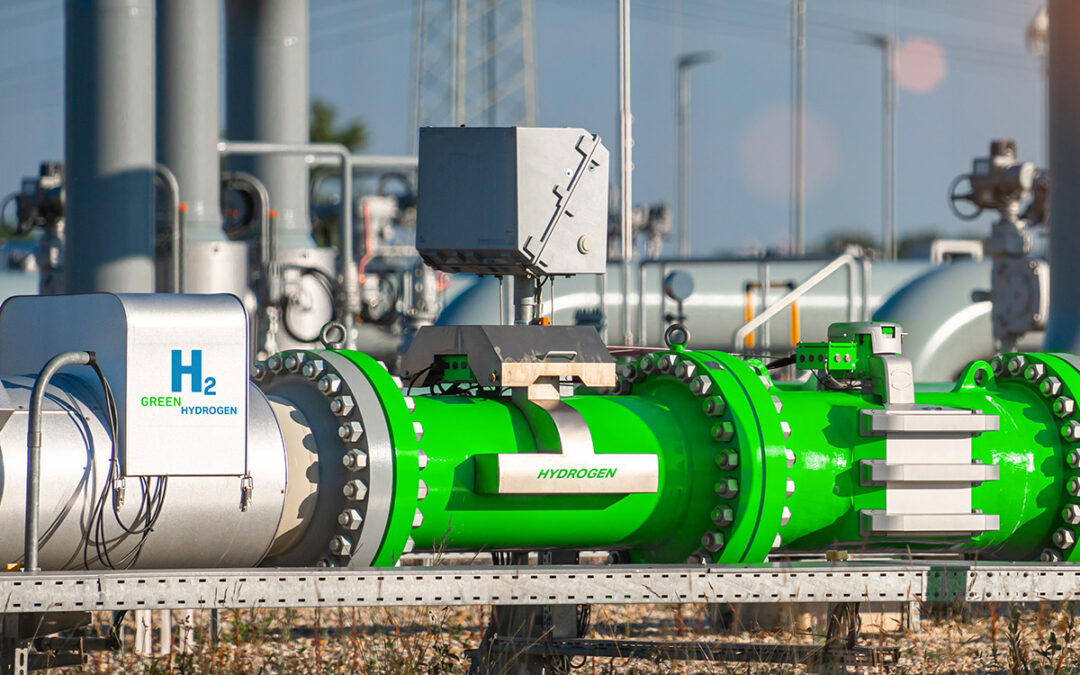
While 5G-PortVG focuses on connectivity, LIHYP addresses another infrastructure question: how can hydrogen supply and demand in the North Sea region be reliably brought together? To this end, the Interreg project is developing a joint North Sea Hydrogen Platform and systematically collecting data on demand, production and supply through to 2030. On this basis, company-specific roadmaps and business models are being developed, complemented by work on system integration and standardisation. Here, too, the same fundamental question arises: how can scattered data be turned into a reliable basis for decisions on investment, supply and operation?
At the centre of the industrial use case is a feasibility study for a hydrogen-powered freight train in the German-Dutch border region – on a route where diesel locomotives are likely to remain in use for some time due to incomplete electrification. The study examines the technical, logistical and economic requirements: when does hydrogen logistics become economically viable, what refuelling infrastructure is needed, and which regulatory barriers can be aligned across borders? In this way, LIHYP links the energy question with concrete decisions on location and transport.
For energy-intensive sectors such as chemicals, steel and mechanical engineering, the project creates a reliable planning basis. A structured data base makes energy procurement more predictable and helps assess investment risks at an early stage. This is also relevant across borders – for example for companies delivering from north-western Germany to the Netherlands, Belgium or Denmark and likely to encounter a hydrogen infrastructure that is still being developed. LIHYP therefore shows that hydrogen should not be viewed merely as an energy carrier, but as part of a regional supply system involving data, standards, infrastructure and market logic.
What both projects offer the Mittelstand
Despite their differences, the same lessons run through both projects: technical applications are only ready for deployment when the underlying infrastructure reliably supports them. Network availability and security of supply are not optional extras, but prerequisites. Both projects also show how important real operational data are: only measured latency and throughput values, or collected demand and market data, can turn a concept into a reliable basis for investment.
It is also striking where projects of this kind are more likely to run into difficulties in practice: less often because of the technology itself, and more often because of inconsistent interfaces and regulatory differences between countries and manufacturers. Those who take such barriers into account early gain time. Finally, both projects show that initiatives of this kind can hardly be delivered by individual actors alone. It is the interplay of research, business, municipalities and public funding that creates the depth of implementation that can ultimately serve as a blueprint for other locations.
For companies facing their own infrastructure decisions, 5G-PortVG and LIHYP therefore offer more than a promise of the future: they provide evidence – from real-world operation, not from a white paper.